
What changed in my bag
A few years ago my charging kit was a small bag of its own: two plug adapters, a laptop brick, a phone brick, a multi-port USB charger, and a fistful of cables that never quite matched the devices I'd brought. Half of it stayed in the hotel room. The rest came home tangled.
Now it is three items. The change wasn't buying a cleverer bag — it was realising that a single plug with a proper 45W USB-C PD output can do the job of most of that kit, provided you bring the right cables.
The three things I actually carry
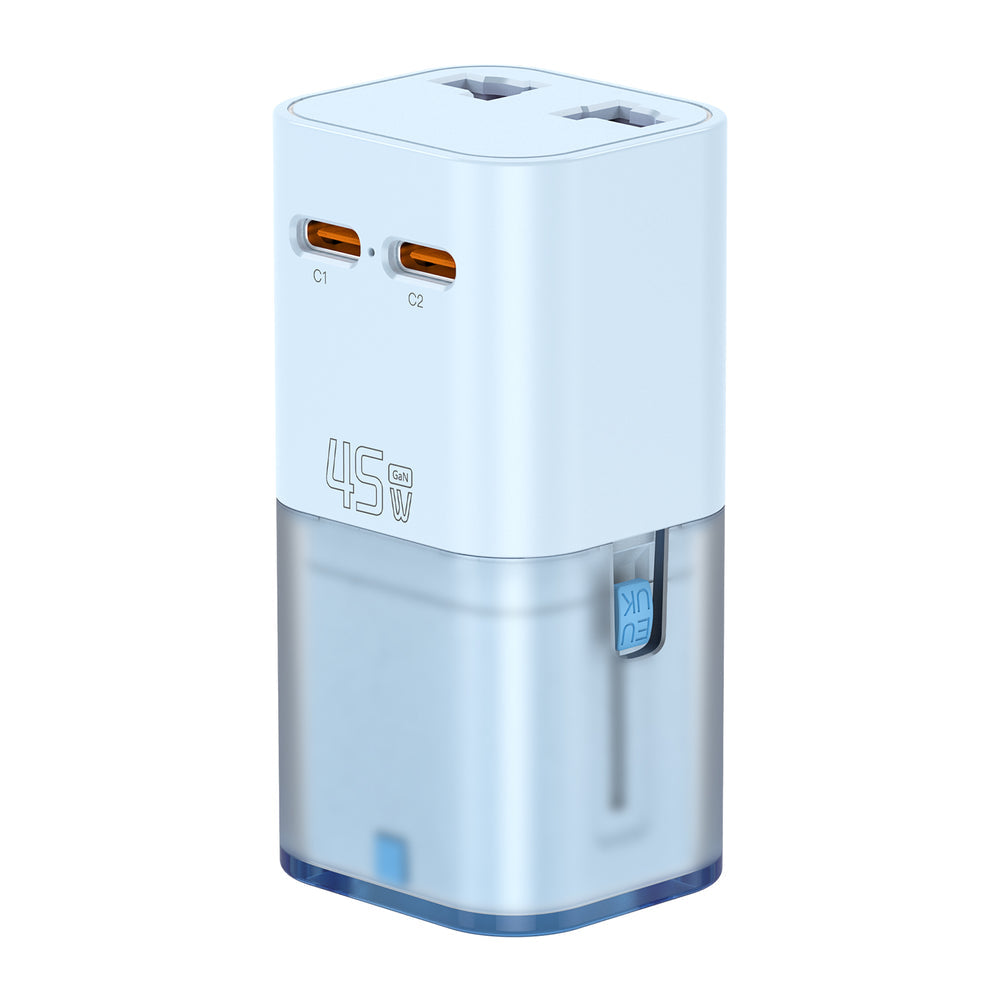
- One OL-H02-PD45 universal travel adapter. Sliding pins for 180+ countries, a 45W USB-C PD port, a 15W USB-A port, and a pass-through AC socket on a 10A auto-resetting fuse. 78 × 39 × 35 mm, so it lives in the outside pocket of the carry-on.
- One USB-C cable rated for 60W or more. This is the one people get wrong. PD negotiation can only deliver 45W if the cable can carry it; a cheap old charge cable will quietly cap you at a fraction of that.
- One short USB-A cable for earbuds, a watch, or a second phone. Short on purpose — it is for the bedside table, not for crossing a room.

Why one 45W plug replaces three chargers
A thin-and-light laptop will run happily on 45W (20V/2.25A), the phone can take the USB-A port overnight, and the AC socket is still free for a camera battery charger or a second device. That is three jobs from one outlet, which is exactly what a hotel room usually gives you — often in an awkward spot behind the bed.
There are two limits worth saying out loud. The USB-A port is 15W, so it is an overnight port, not a "twenty minutes before the flight" port. And 45W will not satisfy a big workstation laptop under load. If your laptop shipped with a 96W or 140W brick, bring it; the adapter is for everything else.
Before you fly: a four-point check
- Read the input label. Anything going into the AC socket must say 100–240V. A travel adapter changes plug shape, not voltage.
- Know the socket type at your destination. EU, UK, US and AU-style pins are built into the slider; one quick check before you leave beats guessing at the airport.
- Leave heating appliances at home. Hair dryers, irons and kettles are both a voltage risk and a load this little unit has no business carrying. Hotels have them.
- Don't rely on public USB ports. A hotel or airport USB socket is slow and, at worst, shared hardware you don't control. Your own plug is faster and yours.

If you're packing for someone else
This is where a simple kit pays off most. When I put a charging set together for my parents, I put a small label on the adapter that just says "push the slider for the country" and taped the two cables to it. No list of plug types, no "which brick goes with which device," no phone call from a hotel at midnight. The 10A fuse and the flame-retardant shell are quiet reassurance when something is left charging overnight.
The same logic works for a student heading abroad for a term: one plug, two labelled cables, done. It's also a much cheaper habit than buying a forgettable adapter at the gate for twice the price.
What I leave at home
The laptop brick (unless it's a high-wattage machine), the spare phone brick, the second and third country plugs, and the cheap multi-port USB charger that always seems to hum. If you travel with a watch and wireless earbuds, a foldable 3-in-1 stand such as the X10 wireless charger is the one extra worth considering — it charges those three Apple-style devices from a single USB-C lead. For a truly minimal kit, the pocket-size X9 magnetic charger is even smaller.

The short version
One adapter with real power delivery, one cable that can carry it, one short cable for the little things — and a ten-second check of the voltage label before anything goes into the AC socket. If you want the full explanation of what the plug can and cannot do, our universal travel adapter guide goes through the specs and the limits in detail.
Pack less, charge everything, and stop tipping out that drawer of orphaned plugs before every trip.