
The problem with "which fan should I buy"
For desk work, a makeup touch-up, or a quick cool-down on a hot train platform, a handheld fan is the most direct tool you can own. We make three of them at BABELMAKE, and the trap is to assume they're just low, mid, and high price. They aren't. Each one solves a slightly different problem, and buying the wrong one means paying for a feature you'll never use — or missing one you needed.
I'm Andy, the founder. I wrote software for about ten years before this, I've been out of university for fifteen years, and I run a small factory in Shenzhen where I personally check the units before they ship. So this comparison comes from the bench, not a marketing meeting. Here's exactly how the three differ. I've carried all three through a Shenzhen summer, and the differences below are the ones I actually felt, not the ones a spreadsheet would suggest. If a detail doesn't change how you'd use the thing day to day, I left it out.

At a glance
- F15 — ~150 g, up to 8 h, turbine-style 5-blade, lightest, $25
- F33 — ~180 g, up to 12 h, folding handle + stand mode, $27
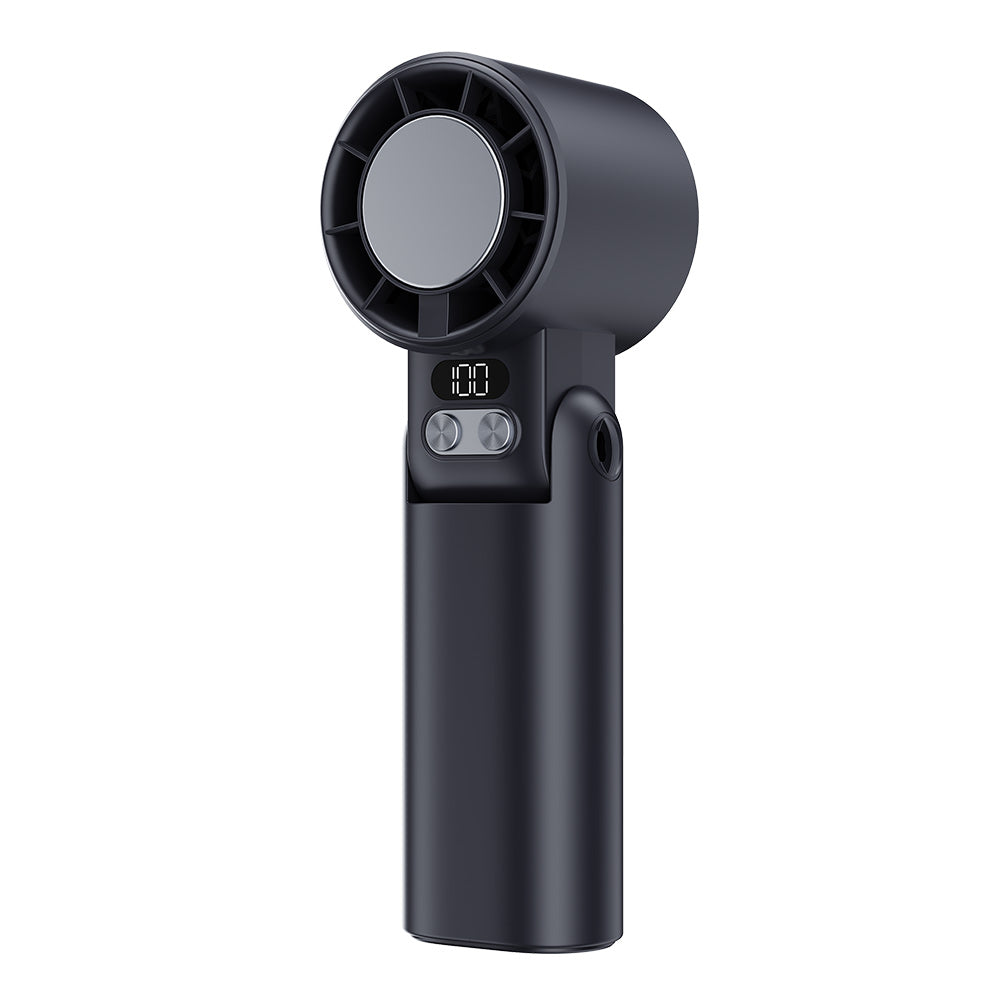
- F35 — ~200 g, up to 14 h, ice-plate cooling + LED display, $29
Those weights are the headline. 150 grams is about the same as a small phone — you genuinely forget it's in your bag. The F35 at 200 grams is heavier, but you're getting a cold-air feature the others don't have, so the extra grams buy something real.
F15 — the always-in-your-bag fan
This is the one I reach for by default. 150 grams, five turbine blades moving a respectable amount of air at low noise, and the lowest price of the three. The only trade-off is that the body doesn't fold, so it takes a fixed rectangle of space in a tote rather than going flat. For most people, that's a non-issue — it's small enough already. If you want the lightest, simplest, "why is this so cheap" fan, it's the F15, full stop. I've dropped mine on concrete more times than I'll admit and it still spins true — the sort of durability you only learn by accident, never from a listing.
F33 — desk by day, pocket by evening
The F33's trick is the folding handle: prop it on a flat surface and it becomes a small desk fan, stand mode and all. Battery life jumps to 12 hours, because the motor is geared lower and sips power. I keep one on my work desk in Shenzhen and fold it into my bag for the commute home. If you want one fan that does double duty — sitting beside your laptop and then traveling with you — the F33 is the smart pick. The ~30-gram step up from the F15 is easy to forgive. On a long-haul flight I'll fold it into the seat-back pocket and use it as a personal vent when the cabin air feels stale; the stand mode means it sits on the tray without tipping, which is the kind of small win you remember on landing.

F35 — the cold-air one
The F35 is the outlier, and my personal favorite for brutal days. A small ice plate (chill it in the freezer for about 10 minutes) lets it blow noticeably colder air than the other two — not just moving warm air, but a genuine chill. It also has an LED display showing the setting, and the longest runtime at up to 14 hours. The trade-off is weight: 200 grams is fine for short sessions but you'll feel it more than the F15 over a long afternoon. For humid, sweat-through-your-shirt summers, that cold stream is worth every gram. I'll be honest that the ice plate is a small ritual — freeze it, clip it in, wait about a minute — but on a 35-degree afternoon that minute buys you the only genuinely cold air in the room, and I reach for it without thinking now.
Handheld or neck fan?
Quick note, because people ask: targeted airflow right on your face — a handheld wins, and these three are exactly that. Continuous airflow that follows you while you walk, hands busy — that's a neck fan, and we make those too. Different problem, different product.
The practical stuff nobody puts up front
All three charge over USB-C — the same cable as your phone, which matters more on the road than you'd think. A full top-up takes about 2 hours. And yes, all three support pass-through charging, so you can keep using them while plugged in if you're parked near an outlet. Little things, but they're the difference between a device you keep and one you abandon. The USB-C point sounds minor until you're in a hotel with one socket and three devices — one cable to rule them is a small mercy at the end of a long travel day, and it's why I never pack a separate charger for these.

So which do I actually buy?
Match it to your most repeated moment:
- Lightest, cheapest, always with you → F15
- Want a desk fan that also travels → F33
- Hot and humid, want the air to feel cold → F35
They're not tiers. They're tools. Pick the one your day asks for, and if you're unsure, the handheld fan collection lays them side by side so you can make the call in thirty seconds.
Last month a customer emailed to say she'd bought the F15 for her commute and the F35 for weekends at her parents' place by the coast, and that the only argument in the house was who got the cold one. That's the comparison in one story: three tools, three moments, zero tiers. Buy the shape of your week, not the price tag.