
The drawer full of plugs
Most of us have a drawer with a tangle of foreign plugs in it. You tip it out before a trip, guess which one goes where, pack three, and still end up asking the hotel desk for a loaner. The other half of the problem is charging: one wall outlet, a laptop brick, a phone brick, and a pair of earbuds all competing for it.
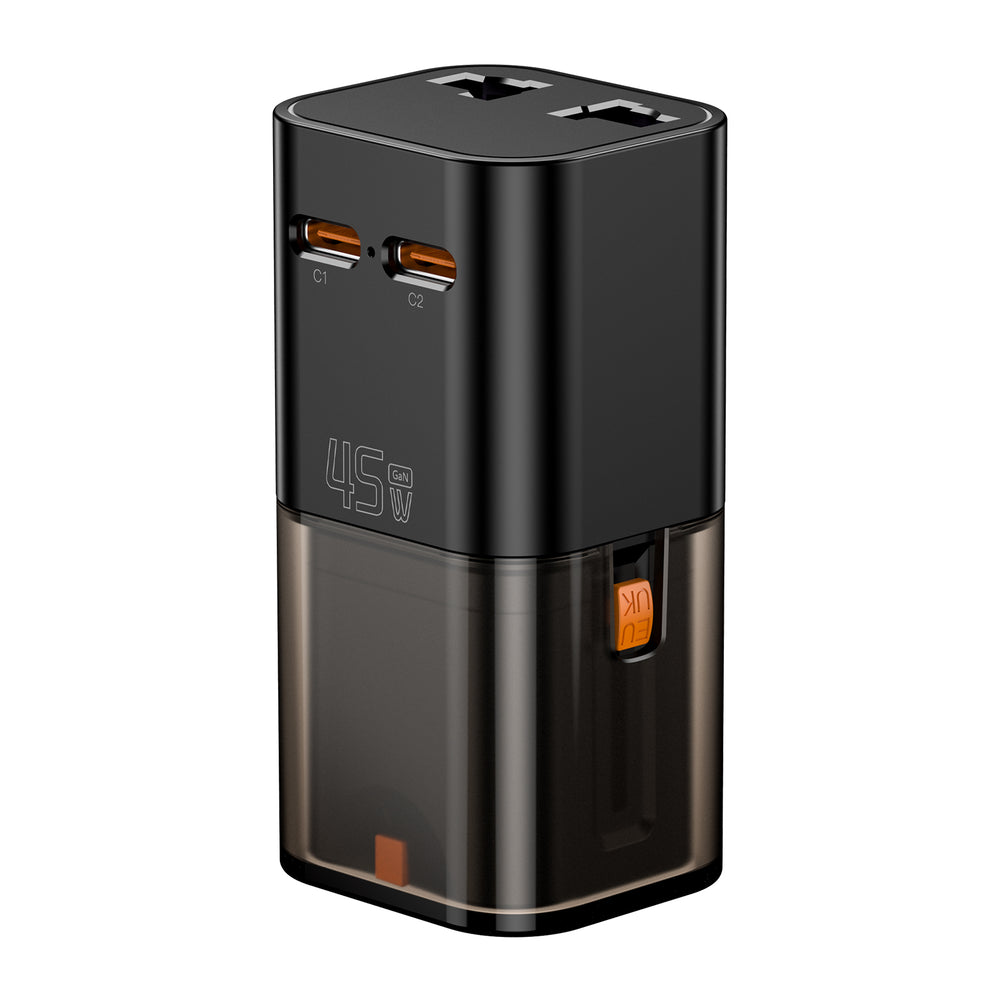
We added the OL-H02-PD45 Universal Travel Adapter because it collapses that whole mess into one 78 × 39 × 35 mm block — roughly the size of a lipstick case. Sliding pins cover the socket standards across 180+ countries, a 45W USB-C PD port handles the laptop, a USB-A port handles the phone, and the pass-through AC socket takes whatever is left.

What 45W actually buys you
Power delivery is the part that separates a useful travel adapter from a plastic brick with a USB hole in it. The published output is worth reading properly:
- USB-C PD: 5V/3A, 9V/3A, 12V/3A, 15V/3A, 20V/2.25A — 45W maximum. That is enough to run a thin-and-light laptop while you work, and to fast-charge a phone or tablet.
- USB-A: 5V/3A, 15W maximum. Fine for a phone overnight, earbuds, or a watch. It is not a fast-charge port, so don't plan a 30-minute top-up around it.
- AC socket: 100–250V, 10A, 2500W maximum, with a 10A auto-resetting fuse and a PC (94V-0 flame-retardant) shell.
I'll be straight about the limit: 45W is not 100W. A 16-inch workstation laptop or a gaming machine will charge slowly, or hold steady rather than gain ground, under load. For the usual travel kit — a 13-inch laptop, a phone, earbuds — it is the right number, and it means the laptop brick stays at home.

The part most listings skip: it does not convert voltage
This is the single most important thing to know before you pack, and it is easy to miss. A travel adapter changes the shape of the plug. It does not change the voltage coming out of the wall. Japan runs 100V, much of Europe 230V, and this unit simply passes that through.
So check the label on every device you plan to plug into the AC socket. If it says `Input: 100–240V~ 50/60Hz` — which covers almost every modern phone charger, laptop brick and camera charger — you are fine. If it says `110V only`, leave it at home. The same goes for high-wattage heating appliances: hair dryers, irons, kettles and space heaters are the classic mistake, both because of voltage and because 2500W is a socket rating, not a promise that a small adapter is a happy home for a heater.
USB devices are the easy case: they take regulated DC from the adapter's own ports, so the wall voltage is the adapter's problem, not your phone's.
How I pack it
Three things go in the bag. The adapter itself, one good USB-C cable rated for 60W or more (a tired old 5V cable will not carry 45W no matter how good the plug is), and one short USB-A cable for the small stuff. That is it.
The pins slide out rather than snapping on as separate pieces, so nothing gets lost in a hotel bedside table. On the safety side, the 10A fuse resets itself instead of leaving you with a dead plug after one surge, and the flame-retardant shell is the sort of spec you only appreciate when you are charging overnight in an unfamiliar room.
One honest quirk: on a loose, older wall socket the whole unit can sag a little under the weight of the cable. It's physics, not a defect — sit it on the desk with a short extension lead, or use the USB ports and skip the AC socket entirely.

Who should buy it, and who should skip it
It earns its place if you cross borders more than once a year, travel with a laptop and a phone, or pack for someone who would rather not think about plug types at all. That last group matters more than it sounds: for an older parent on a first trip abroad, "push the slider for the country" is one less thing to remember, and one less thing to get wrong at 11pm in a hotel room.
Skip it if you only travel domestically, if everything you own is USB-C and you need two or three C ports at once, or if you are trying to take a 110V-only appliance overseas — that needs a real voltage converter, which is a different, heavier, much less travel-friendly product.
For a full packing list, see our international travel charging checklist. If your trip is a drive rather than a flight, the road trip essentials guide covers the car side of the same problem.
The honest setup
One plug, one good cable, and a quick look at the voltage label on anything you plug into the AC socket. Do that and the OL-H02-PD45 universal travel adapter replaces a drawer of adapters and two charging bricks — without pretending to be a transformer it isn't.
---